
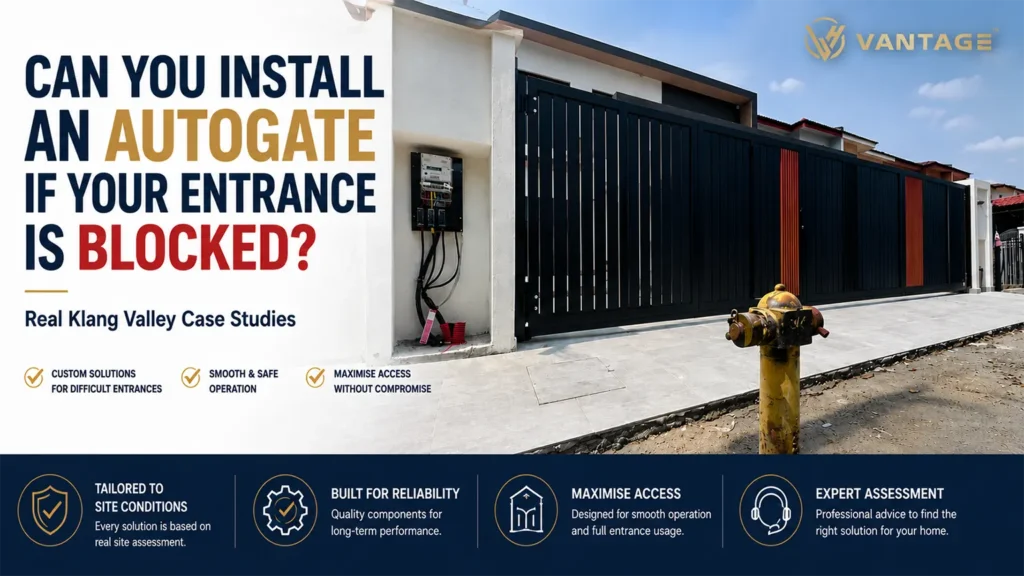
Can You Install an Autogate If Your Entrance Is Blocked? (A Real Case Study In Klang Valley)
Many homeowners assume that installing an autogate is simply a matter of choosing a design they like and fitting it within the available opening.
However, in reality, some homes present challenges that standard autogate designs simply cannot solve.
From fire hydrants and utility structures to uneven road levels and restricted entrance layouts, these obstacles can affect how an autogate opens, operates, and performs over time.
In this article, we’ll share a real Klang Valley case study involving a corner house with a fire hydrant blocking its entrance, along with another project where road level differences required a completely different gate-opening solution.
More importantly, we’ll explain why custom autogate design often matters more than gate size or material when dealing with difficult entrances.
The Common Problem: What Happens When Your Entrance Is Blocked?
Not every home entrance is designed the same way.
In many older residential areas across Klang Valley, homeowners may encounter obstacles such as:
- Fire hydrants
- Utility poles
- TNB boxes
- Drain structures
- Retaining walls
- Existing landscape features
- Uneven road levels
These structures are often permanent and cannot be relocated.
As a result, a standard autogate design may not function properly once installed.
This is where site-specific planning becomes essential.
Real Case Study: A Corner House Entrance Blocked by a Fire Hydrant
One of our recent projects involved a corner house in Klang Valley.
The homeowner had been searching for an autogate solution for quite some time but encountered the same problem repeatedly.
A fire hydrant was positioned directly beside the entrance opening.
While the entrance width was large enough for a gate, the hydrant occupied part of the gate’s opening path.
This meant that many conventional gate configurations would either:
- Hit the fire hydrant during operation
- Have limited opening angles
- Reduce vehicle access convenience
- Create long-term usability issues
The challenge wasn’t whether an autogate could be installed.
The real challenge was how the gate would open.
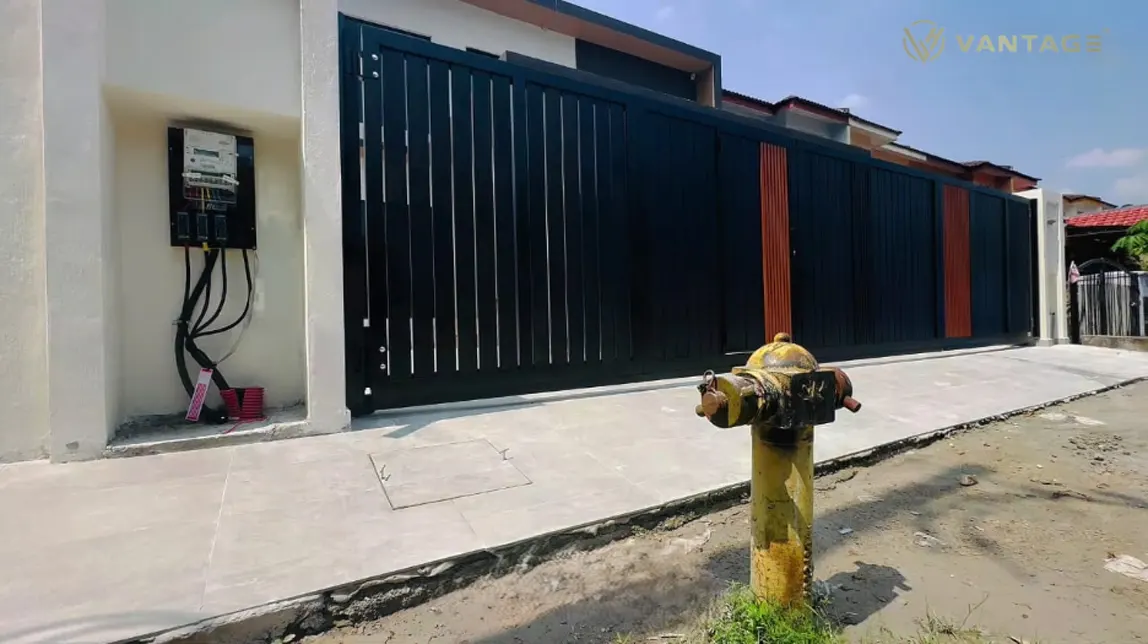
The fire hydrant occupied part of the gate opening path, creating a challenge for conventional gate designs.
Why a Standard Gate Design Wouldn’t Work
A traditional symmetrical folding gate would have required both gate panels to follow similar opening trajectories.
This would have caused one side of the gate to swing directly into the hydrant’s clearance zone.
Reducing the overall gate size was also not ideal, as it would limit vehicle accessibility and compromise daily convenience.
The Solution: A Custom One Compact Panel + One Large Panel
To overcome the obstruction, the gate was redesigned using two different panel sizes.
The final configuration consisted of:
One Compact Gate Panel
Positioned on the side closest to the fire hydrant.
This smaller panel reduced the swing and folding radius around the obstacle.
One Large Gate Panel
Installed on the opposite side to maintain practical vehicle access and balanced aesthetics.
This custom trackless folding gate configuration allowed:
- Smooth gate operation
- Full entrance accessibility
- Clearance from the fire hydrant
- A clean and proportionate appearance
Most importantly, the homeowner was able to use the entire entrance without modifying any public infrastructure.
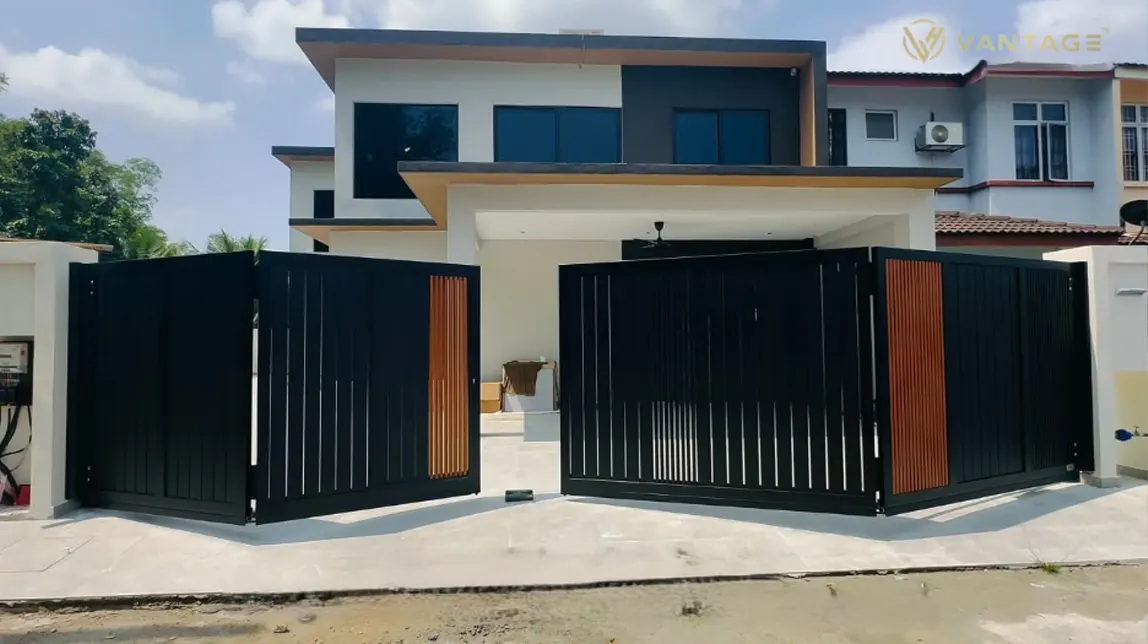
Custom gate configuration featuring one compact panel and one larger panel.
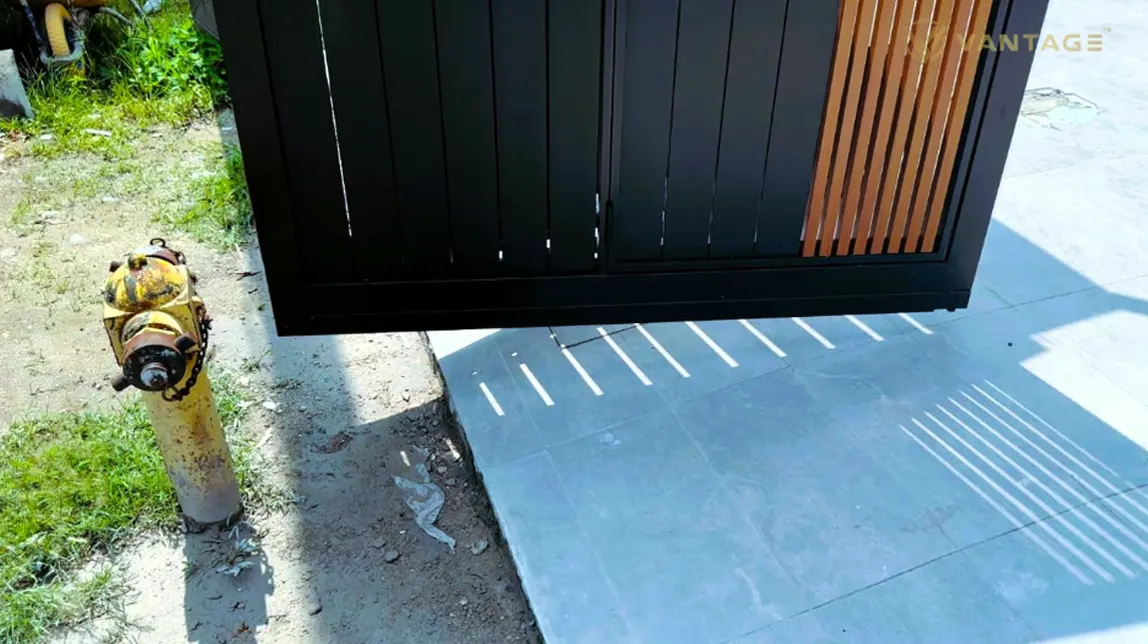
The customised folding path allows the gate to operate without contacting the fire hydrant.
Fire Hydrants Aren’t the Only Obstacle
Many homeowners assume this type of challenge is uncommon.
In reality, we frequently encounter entrances affected by:
Utility Poles
Poles located near gate openings can limit opening angles.
Existing Walls or Structures
Certain wall layouts prevent gates from fully folding outward.
Drainage Features
Wide drains can affect gate positioning and motor placement.
Landscape Elements
Trees, planter boxes, and fixed structures sometimes restrict movement paths.
The good news is that many of these issues can be addressed through proper autogate design rather than major renovation work.
Another Real Example: When the Road Is Higher Than the House
A second project involved a completely different challenge.
In this case, the road outside the property sat higher than the house entrance.
At first glance, the opening appeared suitable for a conventional autogate.
However, once measurements were taken, a problem became clear.
An outward-folding gate would scrape against the ground due to the difference in levels.
The Solution: A Custom In-Fold Trackless Gate
Instead of designing the gate to fold outward, the opening direction was reversed.
The gate was configured as an in-fold trackless gate.
This allowed the gate to:
- Clear the road level difference
- Avoid ground contact
- Operate smoothly
This project demonstrates an important principle.
Sometimes the most effective autogate solution comes from changing how the gate operates rather than changing what the gate is made from.
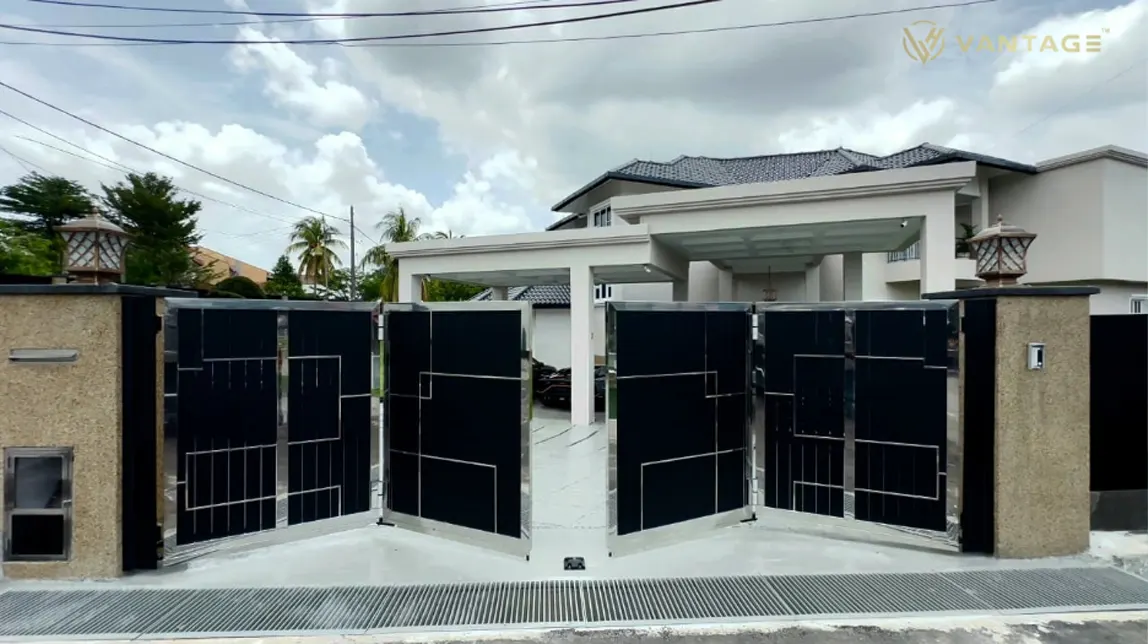
Changing the folding direction solved a problem that a conventional gate design could not.
Other Situations That May Require a Custom Autogate Design
The two projects above are not isolated cases.
Many homeowners face entrance conditions that require customised planning.
Examples include:
| Site Condition | Possible Solution |
| Fire Hydrant | Custom panel configuration |
| Utility Pole | Modified opening path |
| Narrow Entrance | Compact folding layout |
| Uneven Road Level | In-fold gate design |
| Drain Structure | Repositioned gate system |
Every property is different.
This is why professional site assessment remains one of the most important stages of any autogate installation project.
What Homeowners Should Check Before Choosing an Autogate
Before selecting any autogate system, consider the following:
Is there any fixed obstacle near the entrance?
Examples include:
- Fire hydrants
- Utility poles
- TNB boxes
- Trees
- Drain structures
Is the road level higher or lower than your entrance?
Level differences often affect gate opening directions.
Does your entrance have enough clearance?
Vehicle turning radius and gate folding space should both be evaluated.
Has a proper site inspection been conducted?
A professional assessment often identifies potential issues before installation begins.
Why Site Conditions Matter More Than Gate Size
Many homeowners focus primarily on:
- Gate width
- Gate material
- Motor brand
- Design style
While these factors are important, site conditions often have a greater impact on daily usability.
A well-designed autogate should work with the property’s environment rather than against it.
This is especially true for corner houses, sloped entrances, and homes with fixed external obstructions.
Final Thoughts
Can you install an autogate if your entrance is blocked?
In many cases, the answer is yes.
However, successful installation depends on understanding the conditions surrounding the property and designing the gate accordingly.
The fire hydrant case study and the in-fold gate project both highlight the same lesson: there is rarely a one-size-fits-all solution when dealing with challenging entrances.
A well-designed autogate should adapt to the environment, not fight against it.
Whether the challenge involves a fire hydrant, a utility pole, limited opening space, or a significant road level difference, the right solution often comes from proper site assessment and customised gate planning rather than forcing a standard design into a unique situation.
If you’re currently facing a similar issue and are unsure what type of autogate solution is suitable for your home, it may be worth arranging a professional site assessment before making any decisions.
At VANTAGE, we regularly work with homeowners across Klang Valley and surrounding areas to evaluate challenging entrance conditions and recommend practical autogate solutions based on the property’s actual layout. In many cases, a customised design can solve problems that initially appear impossible to overcome.
Menu
Products
Contact Information
© Copyright 2026 Vantage