
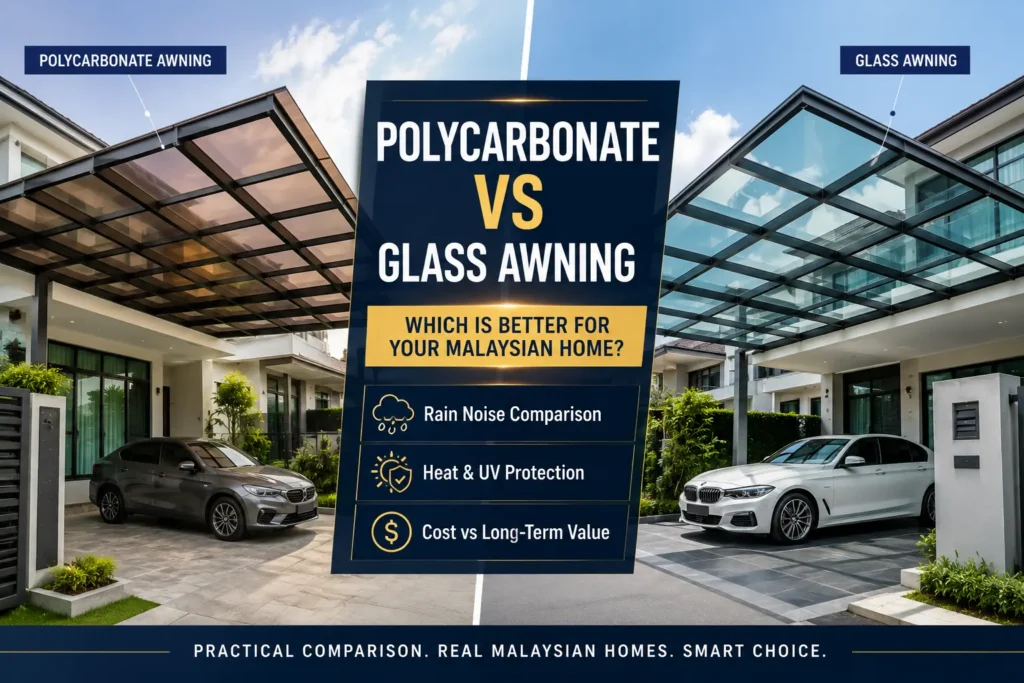
Polycarbonate vs Glass Awning: Which Is Better for Your Malaysian Car Porch & Patio? 2026 Practical Guide
Choosing the right awning for your landed house is not just about picking a colour, style, or roofing material.
Your car porch, patio, side yard, or backyard area has to deal with Malaysia’s daily weather conditions —— strong afternoon sun, sudden heavy rain, humidity, water stains, and years of outdoor exposure. That is why many homeowners compare polycarbonate vs glass awning before deciding what to install.
Both materials can look modern. Both can work well when planned and installed properly. However, they offer different experiences in terms of rain noise, heat control, long-term appearance, maintenance, cost, and overall value.
This guide breaks down the comparison from a practical Malaysian homeowner’s point of view, so you can make a clearer and more confident decision before starting your renovation.
Polycarbonate vs Glass Awning: A Quick Side-by-Side Look
Here is the simple answer:
Solid polycarbonate awning is usually more practical if you want a budget-friendly, functional, and easy-to-maintain roofing solution.
Laminated glass awning is often preferred if you want a quieter, cleaner, and more premium exterior finish.
| Feature | Solid Polycarbonate Awning | Laminated Glass Awning |
| Cost | More budget-friendly | Higher investment |
| Rain Noise | Moderate, depending on thickness and installation | Usually quieter during heavy rain |
| Appearance | Modern, neat, and practical | Premium, clean, and architectural |
| Heat Control | Good with tinted or embossed sheets | Better with tinted or heat-reducing glass |
| Long-Term Clarity | May age or turn yellowish over time, depending on quality | Does not yellow like plastic roofing |
| Maintenance | More forgiving and easier to replace when needed | Dirt and water stains are more visible |
| Best For | Terrace houses, side yards, large functional covers | Semi-D, bungalows, premium patios, modern front entrances |
The better choice depends on your house layout, budget, sun direction, awning size, drainage planning, and how you want the covered space to feel in everyday use.
1. Rain Noise: Which One Is Quieter During Heavy Rain?
Rain noise is one of the most common concerns for Malaysian homeowners.
During a heavy downpour, some awning materials can create a loud “drum effect”, especially if the roofing sheet is thin, hollow, or poorly installed. This can be uncomfortable if the awning is connected to your living room, bedroom area, balcony, or patio.
Polycarbonate Awning
A good-quality solid polycarbonate awning is usually much quieter than cheap metal roofing or hollow plastic roofing sheets.
Instead of a sharp, tinny sound, solid polycarbonate usually produces a softer and more muffled rain sound. For a normal car porch or side yard, this is comfortable enough for most homeowners.
However, polycarbonate is not completely silent. The final rain noise level still depends on several factors, including the sheet quality, thickness, awning size, installation method, roof slope, and how close the awning is to your indoor living areas.
Glass Awning
A laminated glass awning is generally quieter during heavy rain because the material feels denser and more solid.
This makes glass a stronger choice for homeowners who are sensitive to rain noise, especially for patios, balconies, front entrances, or premium outdoor areas where comfort is a priority.
The Bottom Line
Choose laminated glass if rain noise is a major concern and you want a quieter outdoor roofing solution.
Choose solid polycarbonate if you want a practical balance between comfort, appearance, and budget.
2. Heat and UV Protection: Which One Performs Better Under Malaysian Sun?
Malaysia’s afternoon sun can make a car porch or patio feel hot and uncomfortable if the wrong material is selected.
Both polycarbonate and glass can reduce direct sunlight exposure, but the actual performance depends heavily on material grade, colour, tint, coating, roof position, and airflow underneath the awning.
Polycarbonate Awning
High-quality UV-coated solid polycarbonate can be a practical choice for Malaysian weather.
Many homeowners prefer tinted, embossed, or darker polycarbonate sheets because they help reduce glare and create a softer shade underneath the awning.
Clear polycarbonate may look bright and clean, but it can allow more light and heat into the covered area, especially if the house receives strong afternoon sun.
For car porch, side yard, or patio areas, tinted or embossed polycarbonate often gives a more comfortable result for everyday use.
Glass Awning
Glass gives a premium and elegant appearance, but clear glass may create a greenhouse effect if it is not planned carefully.
For Malaysian homes, homeowners should consider tinted laminated glass or heat-reducing glass options if the awning area receives strong sunlight.
Glass can look very clean and high-end, but it should not be chosen based on appearance alone. Sun direction, airflow, natural light, and how the space will be used should also be considered before making the final decision.
The Bottom Line
For practical and fuss-free heat control, tinted or embossed polycarbonate is often easier to manage.
For a premium exterior look with better comfort, tinted laminated glass can work well when the site condition and sun exposure are properly assessed.
3. Long-Term Appearance: Yellowing, Stains, and Clarity
A new awning usually looks good on the first day.
The real question is how it will look after several years of exposure to Malaysian sun, rain, humidity, and dust.
That is why long-term appearance is an important part of the polycarbonate vs glass awning decision.
Polycarbonate Awning
Polycarbonate is lightweight, flexible, and widely used for outdoor roofing applications.
However, low-grade polycarbonate may turn yellow, become dull, or look aged after years of exposure to direct sun and rain.
To reduce this risk, homeowners should avoid very cheap hollow sheets for main car porch areas. A better option is to choose solid compact polycarbonate with proper UV protection.
A well-selected solid polycarbonate awning can last many years, but some visual ageing may still happen over time depending on product quality, sun exposure, maintenance, and installation condition.
Glass Awning
Glass does not yellow like plastic roofing, which is one of its strongest advantages.
This is one of the main reasons homeowners choose glass for premium exterior designs. It can maintain a cleaner and clearer look over the long term.
However, glass also shows dirt more clearly. Water stains, bird droppings, dried leaves, dust, and moss can become very visible, especially if the awning can be seen from an upper floor.
So while glass stays clearer as a material, it still needs regular cleaning to maintain its premium appearance.
The Bottom Line
Polycarbonate is practical, functional, and easier to replace if needed.
Glass offers better long-term clarity, but it requires more consistent cleaning to look its best.
4. Site Suitability: What Should You Check Before Choosing?
Before deciding between polycarbonate and glass awning, homeowners should not look at the material alone.
The right choice also depends on your actual house layout, awning size, sunlight direction, drainage route, existing wall condition, and how the covered space will be used.
A small patio cover, a full car porch awning, a side yard extension, and a backyard laundry area may all require different planning, even if the roofing material looks similar.
Instead of asking only “which material is better?”, it is more useful to ask:
- How large is the area you want to cover?
- Does the space receive strong afternoon sun?
- Is the awning mainly for car porch, patio, laundry area, or walkway protection?
- Where should rainwater flow after hitting the roof?
- Will the awning block too much natural light inside the house?
- Is the area easy to reach and clean?
- Does the design match your home’s exterior style?
- Will the awning connect visually with your gate, security door, or overall facade?
This is why a proper site assessment is important before confirming the final material.
A good recommendation should not be based on price or a brochure alone. It should consider how the awning will actually perform in your own home environment.
5. Cost: What You Pay Now vs What You Get Later
Cost is often one of the biggest deciding factors when comparing polycarbonate vs glass awning.
In general, polycarbonate is more budget-friendly, while laminated glass is a higher-investment option.
However, homeowners should avoid comparing only the price per square foot of the roofing sheet itself. A complete awning quotation may include material specification, finishing, drainage, sealing, labour, installation difficulty, dismantling work, disposal, and overall design requirements.
This is why two quotations can look very different even when both mention “polycarbonate awning” or “glass awning”.
When Polycarbonate Gives Better Value
Solid polycarbonate usually gives better value when:
- The covered area is large
- Budget is a main concern
- The house is a terrace or link house
- You want practical protection from sun and rain
- You prefer a lighter and less bulky appearance
- You may want to replace or upgrade the roofing in the future
- The area is mainly for everyday functional use
For many Malaysian landed homes, solid polycarbonate is a sensible choice for car porch, side yard, backyard, and laundry area coverage.
When Glass Gives Better Value
Laminated glass may give better value when:
- The awning is highly visible from the front
- You want a more premium exterior appearance
- Rain noise is a serious concern
- You are upgrading a Semi-D, bungalow, or modern landed home
- You want the awning to match a clean architectural style
- Long-term visual clarity is important
- The covered area is part of your home’s overall design statement
Glass is not necessary for every area. But when used in the right place, it can elevate the entire look of the home exterior.
The Bottom Line
Polycarbonate usually wins on practical budget and everyday functionality.
Glass wins on premium appearance, rain comfort, and long-term visual value.
6. Maintenance: Which One Is Easier to Take Care Of?
In Malaysia’s weather, every awning needs some level of maintenance.
Rain, dust, leaves, bird droppings, humidity, and moss can affect any outdoor roofing material over time.
Polycarbonate Awning Maintenance
Polycarbonate is generally more forgiving for daily use.
It does not show water stains as clearly as glass, especially when tinted or embossed sheets are used. This makes it suitable for homeowners who want a practical and easygoing material.
However, homeowners should avoid harsh chemicals, rough brushes, or aggressive scrubbing because these may damage the surface coating.
Basic maintenance includes:
- Gentle washing
- Clearing leaves from gutters
- Checking sealant condition
- Watching for trapped dirt
- Making sure rainwater flows properly
Glass Awning Maintenance
Glass looks premium, but dirt is more visible.
Water stains, dust, bird droppings, and moss can make a glass awning look untidy if it is not cleaned regularly.
The advantage is that glass can often be restored to a clearer look through proper cleaning. Once polycarbonate starts to yellow or become dull due to ageing, it may not return to its original clarity.
The Bottom Line
Polycarbonate hides dirt better and feels easier for everyday use.
Glass looks more premium, but it needs more regular cleaning to maintain a clean appearance.
7. Common Awning Mistakes to Avoid in Malaysia
Many awning problems do not come from the material itself.
They often come from unclear quotations, poor workmanship, unsuitable material selection, weak drainage planning, or choosing based on price alone.
Before confirming your awning project, watch out for these common mistakes.
Mistake 1: Choosing Only the Cheapest Quote
The cheapest quotation may look attractive at first, but it may not include proper finishing, sealing, flashing, drainage planning, or suitable material quality.
A low upfront cost can become expensive later if the awning leaks, traps water, causes wall stains, rusts, or needs early replacement.
When comparing quotations, do not only look at the final price. Look at what is included, what material is being used, how drainage is handled, and whether the contractor has considered your actual site condition.
Mistake 2: Using Hollow Polycarbonate in the Wrong Area
Hollow polycarbonate sheets can be cheaper, but they may trap dirt, insects, moisture, and algae inside the gaps over time.
For main car porch areas, many homeowners prefer solid compact polycarbonate because it gives a cleaner and more durable appearance.
This does not mean hollow sheets have no use at all. It simply means they may not be the best choice for every visible or long-term outdoor area.
Mistake 3: Using the Wrong Type of Glass for Overhead Roofing
For overhead awning use, safety should come before appearance.
Homeowners should avoid ordinary glass for roof applications. Laminated safety glass is generally the more appropriate option because it is designed to hold together better if cracking occurs.
The final result still depends on proper material selection, installation method, workmanship, and site suitability.
Mistake 4: Forgetting About Drainage
A beautiful awning can still become a problem if rainwater does not flow properly.
Poor drainage planning may cause dripping, water splashing, wall stains, or leakage near the house wall.
Before installation, make sure the drainage direction, gutter position, and water discharge point are clearly discussed.
In Malaysia, where sudden heavy rain is common, drainage should never be treated as an afterthought.
Mistake 5: Not Checking Local Council Requirements
Local council requirements can vary depending on location, property type, renovation scope, and whether the awning changes the built-up area or affects the front boundary.
Small awning works and larger extensions may be treated differently.
For major front porch changes, corner lots, shared boundaries, or renovation works that may affect neighbours, it is safer to check with the relevant local council or consult a qualified contractor before starting.
8. So, Which Awning Should You Choose?
There is no single answer for every home.
The best material depends on your house design, budget, site condition, lifestyle, and how you want the covered space to function every day.
Choose Solid Polycarbonate Awning If You Want:
- A more budget-friendly solution
- Reliable protection from sun and rain
- A lighter and less bulky appearance
- Good coverage for larger areas
- A practical everyday roofing material
- Easier replacement in the future
- A sensible choice for terrace houses, side yards, and backyards
Solid polycarbonate is a practical workhorse for many Malaysian landed homes.
It may not look as premium as glass, but it performs well when the right grade is selected and the installation is properly planned.
Choose Laminated Glass Awning If You Want:
- A more premium exterior look
- Better rain noise control
- Long-term clarity without yellowing
- A clean architectural appearance
- A more elegant patio or front entrance
- A solution that suits a Semi-D, bungalow, or modern landed home
- A material that complements a high-end exterior design
Laminated glass is suitable when design, comfort, and premium finishing are the main priorities.
It is not always necessary for every area, but it can make a strong visual difference when used in the right part of the home.
Final Thoughts: The Best Awning Is the One That Fits Your Home
When comparing polycarbonate vs glass awning, do not choose based only on which material is more expensive or more popular.
Polycarbonate is practical, budget-friendly, and suitable for many everyday car porch and patio applications. Glass is premium, quieter during rain, and visually long-lasting when used in the right setting.
The key is to decide based on your actual house layout, sun exposure, drainage needs, maintenance expectations, and overall exterior style.
For homeowners in Klang Valley and surrounding areas, VANTAGE can help assess your car porch, patio, or exterior layout before recommending a suitable awning solution. Whether you are considering polycarbonate, glass, or a more complete exterior upgrade together with autogate and security door planning, a proper site assessment can help you avoid costly mistakes and achieve a cleaner, safer, and more well-coordinated result.
Frequently Asked Questions
Is polycarbonate awning good for Malaysian weather?
Yes, high-quality UV-coated solid polycarbonate can be suitable for Malaysian weather. It is practical, lightweight, and commonly used for car porch, patio, side yard, and outdoor coverage.
However, homeowners should avoid very low-grade materials if long-term appearance and durability are important.
Does polycarbonate awning turn yellow?
Polycarbonate may turn yellow over time, especially if the sheet is low-grade or does not have proper UV protection.
Better-quality solid polycarbonate with UV coating usually lasts longer, but some minor ageing may still happen depending on sun exposure, maintenance, and installation condition.
Is glass awning too hot for a car porch?
Clear glass can feel hot if your car porch receives strong afternoon sun.
For better comfort, homeowners can consider tinted laminated glass or heat-reducing glass options. Sun direction, airflow, and how the space will be used should also be considered.
Which awning is quieter during heavy rain?
Laminated glass is generally quieter during heavy rain because it feels denser and more solid.
Solid polycarbonate is still acceptable for many homes, but it may produce more noticeable rain sound compared with glass.
Is laminated glass safe for an awning roof?
Laminated safety glass is generally more suitable for overhead awning use because it is designed to hold together better if cracking occurs.
However, safety still depends on the right material selection, installation method, workmanship, and site suitability.
Which awning is better for a terrace house?
For most terrace houses, solid polycarbonate is often the more practical choice because it is cost-effective, functional, and suitable for everyday car porch or side yard use.
Glass can still be considered if the homeowner wants a more premium front elevation.
Which awning is better for a Semi-D or bungalow?
For Semi-D and bungalow homes, laminated glass often matches a premium architectural style better.
However, polycarbonate can still be a smart choice for larger side yards, backyards, laundry areas, or functional covered spaces.
Do I need local council approval to install an awning in Malaysia?
It depends on your local council, property type, and scope of work.
Small awning works and major extensions may have different requirements. Homeowners should check with the relevant local council or consult a qualified contractor before starting major awning works.
Menu
Products
Contact Information
© Copyright 2026 Vantage