
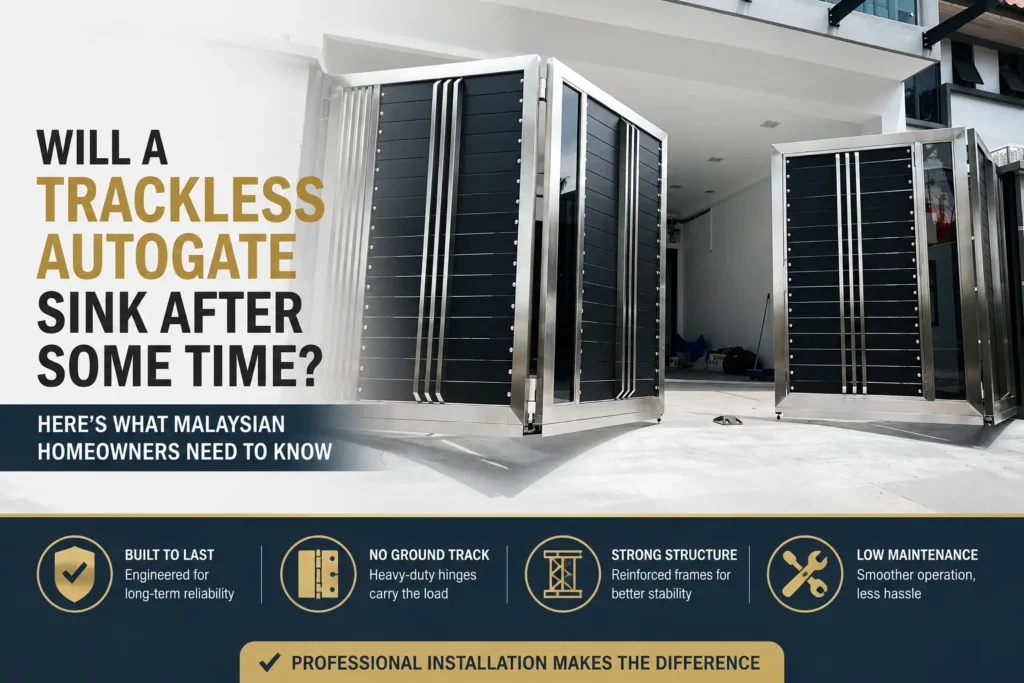
Why Is a Trackless Autogate Reliable, or Will It Sink After Some Time? Here’s What Malaysian Homeowners Need to Know
“Is a trackless autogate actually reliable, or will it eventually sink and scrape the ground?”
If you’re comparing a traditional tracked autogate with a trackless folding gate, you’ve probably asked yourself this question.
It’s a reasonable concern. Traditional gates rely on wheels and ground tracks to support their weight, so it’s natural to wonder how a trackless autogate stays stable without either.
The good news is that a properly engineered and professionally installed trackless autogate should not sink simply because it has no ground track.
In reality, long-term reliability depends far more on the gate’s structural design, component quality, installation workmanship, and ongoing maintenance than on whether it has a track.
In this guide, we’ll explain how a trackless autogate works, what actually causes gates to become uneven over time, and how to choose a reliable system for your home.
Why Do People Think Trackless Autogates Will Sink?
Most homeowners picture a heavy gate being supported by wheels on the ground.
So when they see a trackless folding gate, the first thought is often:
“If there’s no track, what’s supporting all that weight?”
The answer lies in the engineering.
Instead of relying on wheels and a ground track, a trackless autogate distributes its weight through:
- Heavy-duty hinges
- A reinforced gate frame
- Properly anchored gate pillars
- Balanced folding panels
Think of your front door. It doesn’t need wheels because the hinges are designed to support its weight. A well-engineered trackless autogate works on the same principle, just on a larger scale.
What Does “Sinking” Actually Mean?
Interestingly, what homeowners describe as a gate “sinking” often isn’t the gate sinking at all.
Here are some of the most common symptoms.
| What You Notice | Possible Cause |
| Gate touches the ground | Hinge alignment issue |
| Folding panels look uneven | Frame distortion |
| Gate drags during operation | Pillar or foundation movement |
| One side sits lower | Weak structural design |
| Rough or jerky movement | Worn hinges or hardware |
In many cases, the issue comes down to installation quality, structural engineering, or component wear—not the absence of a ground track.
How Does a Trackless Folding Gate Support Its Weight?
A properly designed trackless folding gate spreads its load evenly rather than placing all the weight on a single point.
Heavy-Duty Hinges Do the Hard Work
The hinges are one of the most important parts of the entire system.
Quality hinges are designed to:
- Support the gate’s weight
- Maintain alignment during daily use
- Withstand thousands of opening and closing cycles
- Reduce stress on the gate frame
This is why hinge quality has a significant impact on long-term reliability.
A Strong Frame Keeps the Gate Stable
A reliable gate is more than just stainless steel or aluminium.
Its performance also depends on:
- Proper structural reinforcement
- Appropriate material thickness
- Quality welding
- Balanced weight distribution
A gate may look impressive when it’s first installed, but without proper engineering, problems can appear much sooner.
Folding Panels Help Share the Load
Instead of one large gate panel carrying all the weight, a folding design divides the load across multiple connected panels.
This helps reduce stress on individual components and contributes to smoother operation over time.
What Actually Causes a Trackless Autogate to Become Uneven?
If a trackless autogate develops alignment issues after several years, the trackless design itself is rarely the main cause.
Here are the most common reasons.
Poor Installation
Even a high-quality gate can develop problems if it isn’t installed correctly.
Examples include:
- Incorrect hinge alignment
- Poor anchoring
- Inaccurate measurements
- Misaligned gate pillars
Professional installation plays a major role in long-term performance.
Weak Structural Design
Not all trackless gates are engineered to the same standard.
Warning signs include:
- Thin gate frames
- Large unsupported spans
- Limited internal reinforcement
- Weak welding
A stronger structure generally delivers better long-term durability.
Low-Quality Components
Some systems use lighter-duty hardware to reduce costs.
Components such as hinges, bearings, and brackets naturally experience wear over time, making their quality especially important.
Ground or Pillar Movement
Sometimes the gate itself is not the problem.
Natural soil settlement or slight movement of the supporting pillars can affect the alignment of both tracked and trackless gates.
Oversized Gates Without Proper Engineering
Wide entrances, corner houses, and custom gate designs require additional planning and reinforcement.
Without proper engineering, larger gates experience greater structural stress during daily operation.
Trackless Autogate vs Traditional Tracked Gate
If you’re deciding between the two systems, here’s a practical comparison.
| Feature | Trackless Folding Gate | Traditional Tracked Gate |
| Ground track | Not required | Required |
| Ground wheels | No | Yes |
| Dirt and debris buildup | Minimal | More common |
| Risk of derailment | None | Possible |
| Cleaning requirement | Lower | Higher |
| Uneven driveways | More adaptable | May require additional adjustments |
| Routine maintenance | Lower | Higher |
Traditional tracked gates remain a reliable option.
However, because they rely on ground tracks and wheels, they generally require more frequent cleaning and maintenance—particularly in Malaysia’s tropical climate, where rain, sand, leaves, and debris can accumulate over time.
Does the Gate Material Affect Reliability?
Many homeowners wonder whether stainless steel or aluminium is the better choice.
The answer depends less on the material itself and more on how the gate is designed and built.
Stainless Steel Gates
Stainless steel is often chosen for its:
- Excellent structural strength
- Long-term durability
- Classic, timeless appearance
Aluminium Gates
Aluminium is popular for its:
- Clean, modern aesthetics
- Design flexibility
- Wide range of contemporary finishes
Engineering Matters More Than Material
Whether you choose stainless steel or aluminium, proper engineering, quality fabrication, and professional installation have a much greater influence on long-term reliability than the material alone.
How Long Should a Trackless Autogate Last?
There isn’t a single lifespan that applies to every gate.
How long a system lasts depends on:
- Installation quality
- Daily usage
- Environmental conditions
- Routine maintenance
To maximise the lifespan of your trackless autogate:
- Inspect hinges regularly.
- Tighten loose hardware when needed.
- Keep moving parts clean.
- Address small alignment issues early.
- Follow the recommended servicing schedule.
Routine maintenance helps prevent small issues from becoming costly repairs.
How to Choose a Reliable Trackless Autogate
If you’re comparing different suppliers, don’t focus only on appearance or price.
Instead, ask these questions.
1. Is the Gate Properly Engineered?
Ask about:
- Frame construction
- Reinforcement
- Welding quality
2. Are Heavy-Duty Components Used?
Look beyond the gate panels.
Quality hinges, bearings, brackets, and hardware all contribute to long-term reliability.
3. Is the Motor Matched to the Gate?
The motor should be suitable for the gate’s size, weight, and expected daily usage.
A properly matched motor helps reduce unnecessary stress on the system.
4. Does the Installer Have Relevant Experience?
Experience becomes especially important for:
- Corner houses
- Wide entrances
- Sloped driveways
- Challenging site conditions
An experienced installer is more likely to recommend the right structural solution from the start.
Common Mistakes Homeowners Make
Avoid these common mistakes when choosing an autogate.
- Choosing the lowest quotation without considering quality
- Assuming every trackless gate is built the same
- Comparing only stainless steel and aluminium
- Ignoring structural engineering
- Overlooking installation workmanship
A lower upfront price doesn’t always translate into better long-term value.
Frequently Asked Questions
Can a trackless autogate support a large gate?
Yes. When properly engineered with suitable reinforcement and heavy-duty components, trackless systems can support large residential gates.
Can a trackless gate become uneven over time?
Yes, but this is usually caused by installation quality, structural movement, or component wear rather than the trackless design itself.
Is a trackless folding gate suitable for Malaysian weather?
Yes. Without a ground track, there is less chance of dirt, leaves, or debris affecting daily operation, making it well suited to Malaysia’s climate.
Does a trackless autogate require maintenance?
Yes. Regular inspection and servicing help maintain smooth operation and extend the lifespan of the system.
Final Thoughts
So, is a trackless folding autogate reliable, or will it sink after some time?
When properly engineered and professionally installed, a trackless folding autogate is designed to provide years of reliable performance without sinking simply because it has no ground track.
Ultimately, long-term reliability comes down to good engineering, quality components, professional installation, and regular maintenance—not whether the gate operates with or without a track.
Need Help Choosing the Right Autogate?
Every home is different, and the right solution depends on factors such as your entrance layout, gate size, and site conditions.
If you’re considering a trackless folding gate, VANTAGE provides professional consultation to help you choose a system that’s built for long-term reliability.
We currently serve homeowners across the Klang Valley and surrounding areas.
Menu
Products
Contact Information
© Copyright 2026 Vantage